
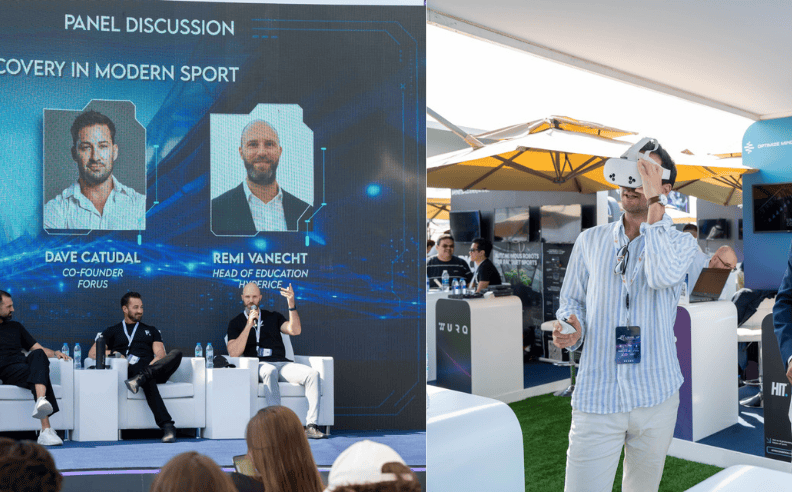
Leading experts and key figures in the fitness industry weighed in on why quality sleep and smart recovery habits are essential for performing at your best and living a more productive, successful life.
At the inaugural LEVEL UP – Dubai’s first Sports Tech Expo, launched by Global MICE Organisation Limited (GMOLx) in collaboration with Dubai Sports Council (DSC) – more than 4,000 visitors had the pleasure of listening to over 70 speakers for key insights. One of the panel discussions was Recharge to Perform: The Science of Recovery in Modern Sport which brought together leaders from WHOOP, Eight Sleep, Forus and Hyperice to explore the fundamentals of modern recovery.
Speakers highlighted the importance of actionable data, personalized sleep science, gut health’s central role in performance, and the need to view recovery as a holistic system rather than a single intervention. Collectively, the discussion offered practical insights into longevity, consistency and the technologies shaping high-performance wellbeing.
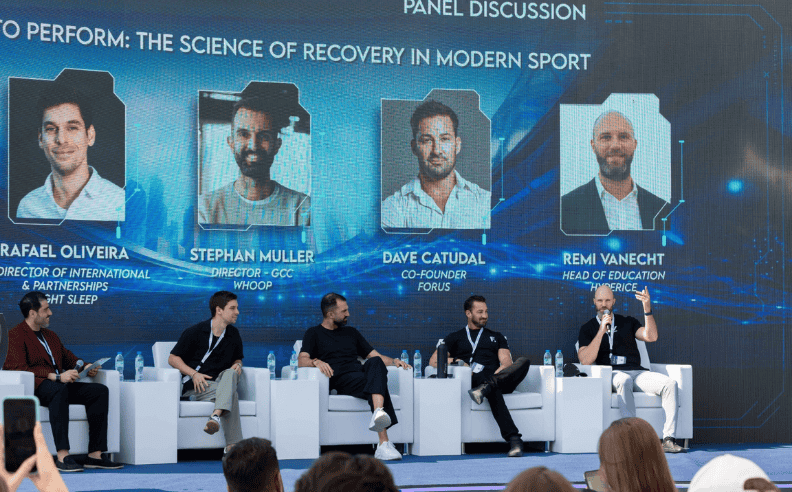
Throughout the panel, one message was consistently reinforced: sleep is not a luxury or a passive state, but a strategic pillar of performance. Speakers emphasized that while training provides the stimulus for improvement, it is recovery, and specifically sleep, that allows the body and mind to adapt. This shift in mindset reflects a broader evolution within high-performance sport, where recovery is no longer treated as an add-on, but as a competitive advantage that underpins long-term success.
Stephan Muller, Director of WHOOP GCC, spoke about the growing role of data in helping individuals better understand their recovery patterns. With access to metrics such as sleep stages, strain and heart rate variability becoming increasingly common, the challenge is no longer obtaining information, but understanding how to interpret and apply it. Muller highlighted the importance of focusing on core fundamentals including sleep consistency, recovery balance and overall strain rather than becoming overwhelmed by numbers. According to the discussion, data only becomes valuable when it leads to actionable insight and the right decision-making.
From a sleep environment perspective, Eight Sleep’s Head of International & Partnerships, Rafael Oliveira addressed widespread misconceptions around temperature and rest. He explained that optimal sleep cannot be achieved through a one-size-fits-all approach, particularly given the natural differences in physiology between individuals. Core body temperature also changes throughout the night, meaning static sleep conditions are often counterproductive. Thermoregulation playing a key role in supporting deep and REM sleep, both of which are essential for physical recovery, cognitive performance and overall wellbeing.
The conversation also extended beyond sleep alone, with panelists emphasizing the interconnected nature of recovery. Dave Catudal, Co-Founder of Forus, highlighted the role of gut health and inflammation in shaping recovery outcomes. He noted that modern lifestyles characterized by constant stimulation, stress and disrupted sleep patterns often place strain on the body’s core systems. Addressing inflammation and gut health, he explained, can have many benefits, improving sleep quality, resilience and long-term health. Supplements, within this context, were positioned not as shortcuts, but as tools that support recovery when paired with consistent habits and routines.

Hyperice’s Head of Education, Remi Vanecht reinforced the idea that recovery should be viewed as a system rather than a single intervention. Drawing from his experience working with elite athletes, he explained that the most effective recovery strategies are built around consistency. While professional athletes may have access to advanced tools and support teams, the principles they follow are universally applicable. Structured routines, intentional recovery practices and commitment to small daily actions often produce greater long-term results than chasing the latest trends.
A recurring theme throughout the discussion was the misconception that recovery can be optimised through isolated hacks. Panelists consistently cautioned against the idea of quick fixes, instead encouraging a gradual and personalised approach to recovery. Sustainable progress, they agreed, comes from building habits that can be maintained over time, beginning with sleep quality and extending to nutrition, movement and mental wellbeing.
The panel also touched on the gap between elite athletes and everyday individuals when it comes to recovery practices. While access to technology and professional guidance may differ, awareness and education were identified as key factors in narrowing that divide. Wearable technology and recovery tools were framed as enablers that support better decision-making rather than replacements for discipline or routine.
As the session concluded, the message was clear. Improving performance begins with redefining the role of recovery. Sleep now sits at the centre of the performance conversation, supported by data-driven tools, informed nutrition choices and consistent recovery behaviours. When approached holistically, recovery becomes a foundation for sustained health, longevity and performance.
The Recharge to Perform panel reflected LEVEL UP’s broader mission to move beyond innovation showcases and foster meaningful conversations around the future of sport. By bringing together leaders across the recovery ecosystem, the discussion offered valuable insights for athletes, professionals and everyday performers alike, reinforcing the idea that when recovery is done right, performance naturally follows.
M283 Arabia covers all aspects of men's lifestyle; fashion, sports, self-care, and travel tips and destinations.





 SHARE
SHARE