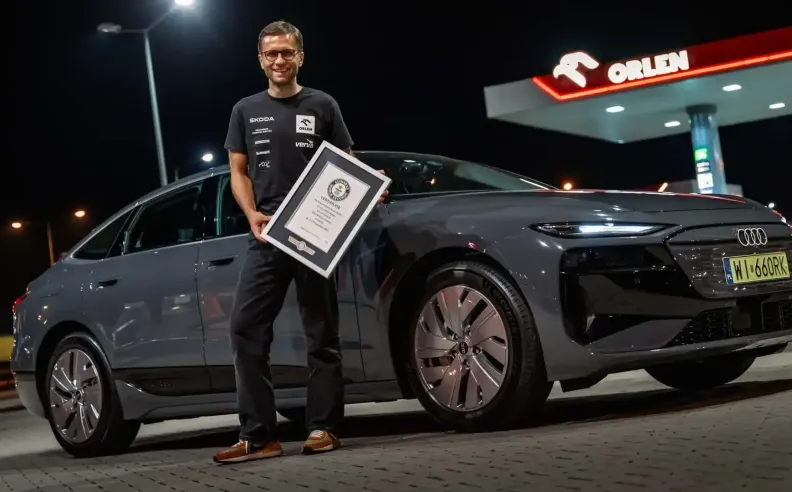
The Audi A6 Sportback E Tron has pushed electric vehicle efficiency to an impressive new level after Polish rally driver Miko Marczyk covered 1338 kilometers on a single battery charge.
The achievement earned a new Guinness World Record and significantly exceeded the official WLTP driving range of up to 777 kilometers for the production car. Marczyk managed to travel more than 72 percent farther by combining careful driving techniques with the aerodynamic design and efficient electric technology of the A6 E Tron.

The record attempt began in Poland at 1:55 in the morning on September 11 and continued for more than 45 hours.
Instead of using a closed test track under tightly controlled conditions, Marczyk drove the Audi on public roads and through normal traffic. The route included cities such as Krakow, Warsaw and Torun before reaching the Hel Peninsula on the Baltic coast.
Temperatures during the drive ranged between approximately 7 and 15 degrees Celsius. The car continued until its battery was completely depleted between Torun and Ciechocinek.
Completing the attempt in everyday road conditions makes the result particularly interesting because the car still had to deal with traffic, changing speeds and real driving environments.

One of the biggest advantages of the A6 Sportback E Tron is its aerodynamic efficiency.
The Sportback has a drag coefficient of just 0.21, making it one of the most aerodynamically efficient production vehicles Audi has created. Lower air resistance means the electric motors require less energy to maintain speed, especially during longer journeys.
The car also uses a battery with 94.9 kWh of usable capacity.
Its regenerative braking system can recover up to 220 kW of energy during deceleration. Audi says regeneration can handle around 95 percent of everyday braking situations, allowing energy that would otherwise be lost to be returned to the battery.

The most remarkable figure from the journey may be the average energy consumption.
Across the entire 1338 kilometer drive, the Audi reportedly averaged just 7.09 kWh for every 100 kilometers traveled.
That figure is less than half the energy consumption normally associated with the vehicle under standardized driving conditions.
Achieving such efficiency required much more than simply driving slowly. Marczyk focused on smooth acceleration, maintaining momentum, anticipating surrounding traffic and maximizing regenerative braking whenever possible.
Tire pressures and other efficiency focused preparations also played an important role in reducing unnecessary energy losses.
Drivers should not expect to regularly travel 1338 kilometers between charges. The official WLTP range remains a much more realistic reference for normal ownership, while the record required highly optimized driving over an extended period.
The achievement instead demonstrates how much driving style, aerodynamics and energy management can influence electric vehicle range.
Experimental electric vehicles have traveled significantly farther. The TUfast Eco Team, for example, has recorded a distance of 2573 kilometers with a highly specialized efficiency vehicle.
The Audi achievement is different because the A6 Sportback E Tron is a road legal production vehicle available to customers.
For electric car owners, the experiment also highlights several useful lessons. Smooth acceleration, maintaining proper tire pressure, anticipating traffic and making effective use of regenerative braking can all help increase real world range.
The Audi A6 E Tron may not travel 1338 kilometers during a normal commute, but this record shows just how far modern electric vehicle technology can be pushed when efficiency becomes the only objective.

Started my career in Automotive Journalism in 2015. Even though I'm a pharmacist, hanging around cars all the time has created a passion for the automotive industry since day 1.



 SHARE
SHARE