The all-new electric C-Class has been designed from scratch as a battery-electric vehicle, marking the next consistent step in Mercedes-Benz’s electrification strategy in the midsize segment. Numerous sustainability measures, first introduced with the all-new electric GLC, are now also being applied to the all-new electric C-Class. As a result, the C-Class achieves a two-thirds reduction in carbon footprint across its entire life cycle compared to the current combustion-powered C-Class. This is documented in the 360° Environmental Check, which is verified by independent auditors.
Resource efficiency, CO₂ reduction and the circular economy are already key focus areas during the development phase. Together with its suppliers, Mercedes-Benz specifically relies on CO₂-reduced materials such as aluminium, steel, plastics, and battery cells. As a result, CO₂ emissions in the supply chain can be reduced by approximately 23 per cent.
The key contributions to the environmental performance of the all-new electric C-Class:
Design for Environment: Resource conservation measures are firmly embedded in the development process of the all-new electric C-Class. The “Design for Environment” approach considers material efficiency, recyclability and the increased use of secondary raw materials already in the early stages of development.
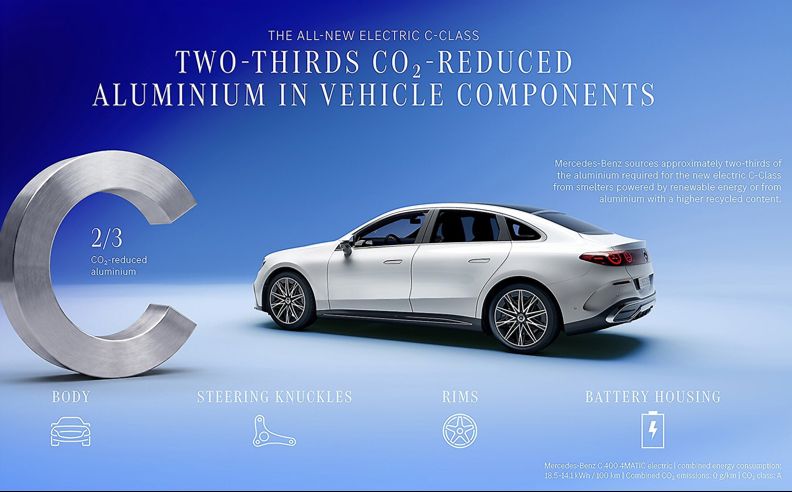
Carbon-reduced aluminium: Mercedes-Benz sources approximately two-thirds of the vehicle’s aluminium requirements from electrolysis plants powered by renewable energy or with an increased share of recycled material. In addition to the body and steering knuckles, components such as the wheels and battery housing are made of aluminium with a reduced carbon footprint.
Carbon-reduced steel: Around 45 kilograms of steel from electric arc furnaces powered by renewable energy are used for the steel components manufactured in-house.
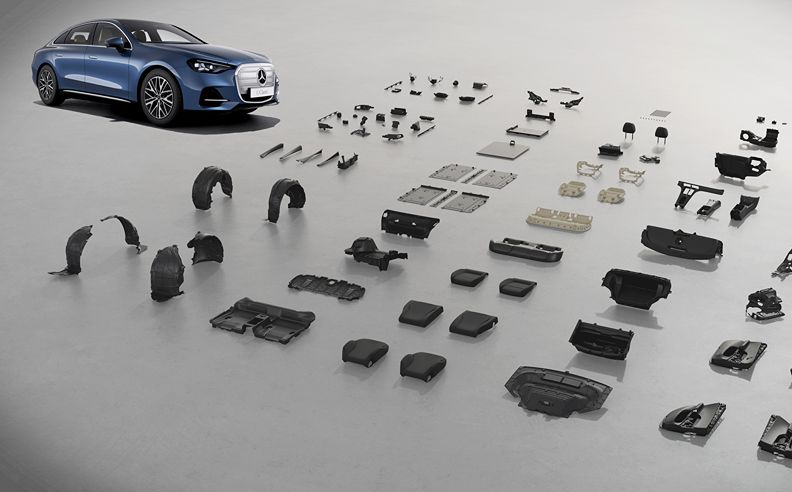
Use of secondary materials: Compared to the C-Class currently in series production, the share of secondary materials in thermoplastics has increased by more than a factor of four. In total, around 49 kilograms of thermoplastic recycled plastic are used. Numerous components are partially made from recycled materials, including:
- Frunk tub with 50 per cent post-consumer recyclate
- Wheel arch liners with 93 per cent recycled content
- Jack mounts made from 100 per cent recycled bumpers from end-of-life vehicles
- Bumper carriers with 83 per cent recycled content
- Nonwoven fabric and yarn in seat covers with 34 and 50 per cent recycled content, respectively
Reduction of carbon emissions during the use phase:
Outstanding range: The all-new electric C-Class has a range of over 762 kilometres on one charge according to WLTP. This makes it suitable for both everyday use and long-distance driving. Further models with rear-wheel and all-wheel drive as well as various battery variants will follow next year. These include a rear-wheel-drive model with an expected range of approximately 800 kilometres.
High efficiency of the electric drive: With a combined energy consumption of 18.5–14.1 kWh/100 km, the all-new electric C-Class is one of the particularly efficient vehicles in its segment.
800-volt architecture: Modern 800-volt technology provides the basis for high efficiency and particularly short charging times.
Standard multi-source heat pump: It combines efficiency with high thermal comfort. The air-side heat pump uses waste heat from the electric drive system and the battery, as well as ambient air, to heat the interior. In doing so, it requires around one-third of the electrical energy that a comparable electric auxiliary heater would need to deliver the same heating output under the same boundary conditions.
High recuperation performance: The C-Class is equipped with a new One-Box braking system. For efficiency reasons, up to 99 per cent of all braking processes are carried out entirely through recuperation. The recuperation output is up to 300 kW, which significantly helps increase range.

Motor 283 is the biggest automotive website created by a team of automotive enthusiats and this author page is used to show the readers the press releases and news posted on Motor 283 website.


 SHARE
SHARE