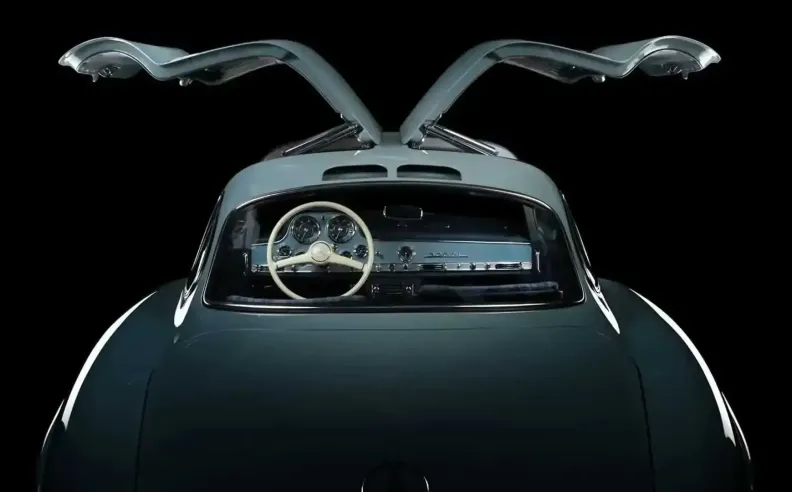
Few classic sports cars are as instantly recognizable as the Mercedes Benz 300 SL, particularly because of its spectacular gullwing doors that open upward like the wings of a bird. While many enthusiasts assume this distinctive feature was created to make the car look more futuristic, the truth is far more fascinating. The famous doors were actually born out of an engineering challenge that Mercedes engineers faced during the development of their racing cars in the early 1950s. What started as a practical solution to a structural problem eventually became one of the most celebrated design features in automotive history, transforming the 300 SL into a timeless symbol of German engineering and innovation.

The story began in 1952 with the Mercedes Benz W194 racing car, developed to compete in prestigious endurance events such as the 24 Hours of Le Mans. To deliver exceptional performance without unnecessary weight, Mercedes engineers created an innovative tubular spaceframe chassis using interconnected steel tubes. This construction provided impressive structural rigidity while keeping the frame remarkably lightweight at approximately 50 kilograms. However, the design presented one major challenge. The structural tubes extended high along both sides of the passenger compartment, creating unusually tall door sills that made conventional doors practically impossible. Cutting through these tubes to create traditional door openings would have compromised the chassis rigidity and reduced the advantages of its lightweight construction. Rather than sacrificing structural performance, Mercedes engineers needed an entirely different approach to passenger access.

Mercedes engineers developed an ingenious solution by relocating the door hinges to the roof, allowing the doors to swing upward instead of opening sideways. This unconventional arrangement preserved the essential chassis structure while allowing occupants to climb over the high side sills and enter the cabin. Special spring mechanisms helped support the doors when opened, while a folding steering wheel made getting into the driver's seat easier. When Mercedes introduced the production 300 SL in 1954, these doors became its most recognizable feature, but the innovation extended well beyond its appearance. The sports car featured a 3.0 liter inline six cylinder engine equipped with mechanical direct fuel injection, an advanced technology that helped it produce 215 horsepower. Depending on its gearing configuration, the 300 SL could reach speeds of up to 260 km/h, making it one of the fastest production cars of its time.

What makes the Mercedes 300 SL particularly remarkable is how an engineering compromise evolved into a defining piece of automotive design. Between 1954 and 1957, Mercedes produced just 1,400 examples of the 300 SL Gullwing Coupe, establishing its reputation as one of the most desirable classic sports cars. Interestingly, when Mercedes introduced the 300 SL Roadster in 1957, engineers redesigned sections of the tubular chassis and lowered the side sills, making conventional doors possible. This change demonstrated that the original gullwing design had been driven by mechanical necessity rather than styling alone. Today, the 300 SL continues to inspire automotive enthusiasts and designers, proving that some of the most memorable innovations emerge when engineers find creative solutions to difficult technical challenges. Its extraordinary legacy reminds the automotive world that exceptional design is often the natural result of intelligent engineering.

Started my career in Automotive Journalism in 2015. Even though I'm a pharmacist, hanging around cars all the time has created a passion for the automotive industry since day 1.


 SHARE